
Working with dogs in health care settings
Downloaded content date
Last reviewed: 06/11/2025
Working with dogs in health care settings
Working with dogs in health care settings
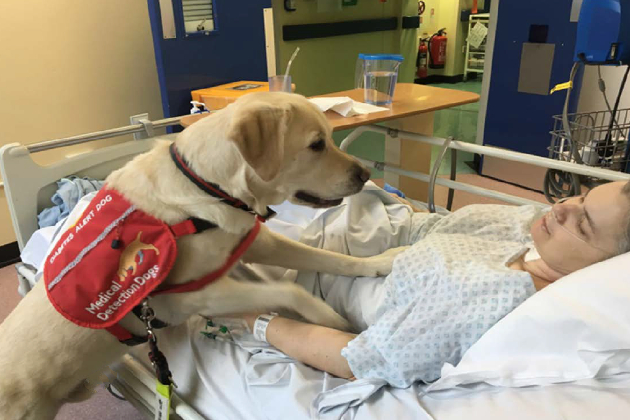
Dogs can play a valuable role in supporting people in health and social care environments. This summary explores how organisations can safely manage dogs in clinical settings, including hospitals, care homes, hospices and patient transport services
Understand the responsibilities of both the dog and the handler about what to consider before allowing dogs on site. This includes staff who use assistance dogs, patients and visitors, and those working with therapy dogs.
Benefits of dogs in health care settings
The presence of dogs can benefit patients, staff and visitors, but it must be carefully planned to protect everyone involved.
Precautions are needed when dogs are brought into health care settings. Each organisation must carry out its own risk assessment and develop a policy that suits its environment.
Types of dogs in health care settings
Dogs may be present in health care settings for different reasons. Here we look at three different categories:
Assistance dogs
These dogs support disabled people and are protected under the Equality Act 2010. They may help with guiding, hearing, mobility, medical alerts, autism or PTSD.
Assistance dogs are usually with their owner at all times and are trained to carry out specific tasks. They may be trained by charities or by the owner, but there is no formal UK register.
Health care providers must allow access to assistance dogs unless there are exceptional circumstances, such as operating theatres or food preparation areas. Emotional support animals are not classed as assistance dogs, as they are not trained to carry out practical tasks.
Animal-assisted intervention (AAI) dogs
These dogs are used in therapy or wellbeing activities. There are two types of dogs providing AAI:
- Animal-assisted therapy (AAT) is goal-based and delivered with health professionals.
- Animal-assisted activity (AAA) involves general visits to offer comfort and interaction.
Dogs may be registered with organisations like Pets as Therapy or specially trained for clinical environments.
Patients’ pet dogs
In most cases, pet dogs should not be allowed into health care settings. While we understand that people may value having time with their pet dog, it is important to recognise that many health care settings are unfamiliar environments for most dogs and can be very unsettling for a dog that has not been temperamentally screened and trained to deal with a very wide range of environments.
Similarly, it is difficult for hospital staff to deal with the requirement to assess a dog’s health and vaccination history. However, exceptions may be made in hospices or care homes. A formal request and risk assessment must be completed before a visit takes place.
Deciding if a dog can visit
Health care professionals should consider four key questions:
- Is the dog trained and needed? A suitable dog will be calm, well-behaved, vaccinated, toilet-trained and covered by insurance. It should not be fed raw meat unless medically necessary and must not show signs of fear or aggression.
- What role does the dog play? Understanding how the dog supports the person helps assess whether its presence is essential. For example, a medical alert dog may reduce the need for staff to monitor a patient constantly.
- What is the clinical context? The environment must be safe for the dog, the patient and others present. Staff with assistance dogs should have a workplace risk assessment, including evacuation plans and consideration of other staff’s allergies or beliefs.
- Who will care for the dog? The owner or a nominated person must take full responsibility. Health care staff are not expected to care for the dog.
Transport guidance
In emergency transport, if the patient is conscious, the dog should travel with them. If unconscious, alternative arrangements should be made.
For non-emergency transport, providers must check whether other passengers may be affected. Vehicles should be cleaned after transport, and dogs must be secured and sit quietly.
Managing risks: Infection prevention and control
There is no evidence of infection outbreaks caused by dogs in health care settings, but precautions must be taken:
- Dogs and handlers must not visit if unwell.
- Dogs must be clean, vaccinated and well-groomed.
- Licking is not allowed, except for medical alert behaviour.
- Protective pads should be used if dogs touch beds.
- Hand hygiene must be maintained before and after contact.
- Raw feeding is discouraged due to infection risks.
Allergy management
Health and safety
High-risk clinical areas
Extra precautions are needed in areas such as intensive care, oncology and emergency departments. Visits must be planned and supported by staff, and patient consent must be obtained. Dogs must be clean, vaccinated and parasite-free, and handlers must be trained and DBS-checked.
Dogs must not enter isolation areas or come into contact with open wounds. Hand hygiene is essential and dogs must not lick or sit on beds. Visits should be limited to one hour per session, with a maximum of three hours per day.
Templates
This publication includes templates for requesting pet visits and assessing staff with assistance dogs. It also provides a guide to understanding dog behaviour.
The full PDF explores this topic in more detail. The publication may include case studies, images, tables, good practice checklists, glossaries and suggested questions to ask patients. You’ll also find a concise list of references and links to useful organisations and websites.
Resource lead
Contact details for the resource lead:
