
Diabetes essentials
Downloaded content date
Last reviewed: 19/02/2025
Diabetes essentials
Diabetes essentials

Use this resource to develop your fundamental knowledge of diabetes mellitus in adults in order to promote safe, competent and compassionate care for people living with diabetes.
Introduction
Diabetes Essentials will also signpost you to other resources to support your learning and professional development. For more information, see: Diabetes: the essentials for non-specialists.
Diabetes Essentials has been developed by the RCN Diabetes Forum and is endorsed by Diabetes UK.
You can review Diabetes Essentials in its entirety, or select relevant sections to review, depending on your area of practice and your pre-existing knowledge. Where appropriate we will suggest other resources for more advanced practitioners.
This resource is designed to provide an overview of:
- the core concepts of diabetes
- diagnosis and current treatments
- your role and responsibilities regarding the treatment of adults living with diabetes
- key concepts in relation to diabetes mellitus are considered, contextualised within case studies in order to relate your learning to practice.
We hope you enjoy this resource. Please do contact the RCN Diabetes Forum with any suggestions in relation to this resource.
Target audience
Diabetes Essentials is for all UK registered nurses, nursing associates, nursing students and allied health care practitioners working with adults. It aims to support the non-specialist practitioner to better understand the needs of people living with diabetes so you can deliver safe and competent care to people who live with diabetes and during periods of illness.
It is designed to support those providing health care in the community, in nursing homes and during hospital admissions.
Being at the forefront of care you are ideally placed to spot symptoms of poor self-management early on and even the first signs of diabetes within an adult. You are also ideally placed to support people with diabetes in maintaining the knowledge, skills, resources, confidence and motivation they need to manage their diabetes effectively within the limits of your own competence and to direct them to other members of the multidisciplinary team (MDT) who can provide this care and support.
Core concepts about diabetes
Diabetes mellitus (DM) is a common long-term health condition characterised by excess levels of glucose in the blood. It is estimated that more than 5.6 million people in the UK are living with diabetes, which is an all-time high (Diabetes UK, 2024). Diabetes UK (2024) data shows that 4.4 million people in the UK live with diabetes. Additionally, 1.2 million people could be living with type 2 diabetes who are yet to be diagnosed’ can we change to: ‘Diabetes mellitus (DM) is a common long term condition characterised by excess levels of glucose in the blood. It is now estimated that more than 5.8 million people in the UK are living with diabetes, the highest number ever recorded. Of these, almost 4.6 million people have a confirmed diagnosis of diabetes. In addition, around 1.3 million people are thought to be living with type 2 diabetes but have not yet been diagnosed, often because early symptoms can be subtle or absent.
Type 2 diabetes is the most common type of diabetes: about 90% of people with diabetes have type 2 diabetes (T2DM) about 8% have type 1 diabetes (T1DM) and about 2% have rarer types (Diabetes UK (2024) Facts and figures).
Diabetes is a condition where the amount of glucose is a person’s blood is too high because their body is unable to process this glucose properly. This could be for two reasons:
- Their pancreas does not produce any insulin or does not produce enough insulin to allow glucose to enter the cells of their body. This is calledinsulindeficiency.
- The insulin they are producing does not work properly. This is called insulinresistance.
For the majority of people diagnosed with diabetes, it is a life-long condition which requires long-term motivation and competence to keep their blood sugar levels as close to normal as they are able. The role of self-managementofdiabetes cannot be over-emphasised. The World Health Organization estimates that 99% of diabetes-related healthcare decisions are made independently by the person with diabetes. This burden is a large part of the reason why diabetes is associated with increased rates of depression (World Health Organization, 2023, Diabetes UK, 2024).
Blood glucose control
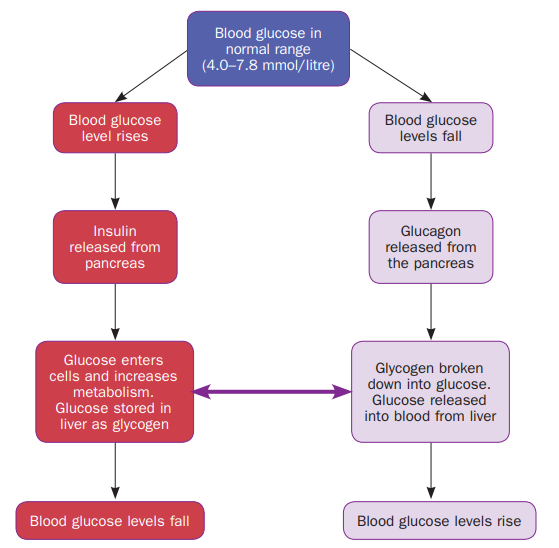
Insulin is essential for life. It is a hormone produced in the pancreas. An important job that insulin does is to move glucose into cells around the body to produce the energy needed for everyday life.
Glucose comes mainly from digesting carbohydrates. Many foods contain carbohydrates. These include starchy foods such as bread, rice, potatoes and chapattis, fruit, some dairy products, sugary food and drinks. For this reason, diet is an important part of diabetes management.
Glucose can be stored in the liver and muscles. When the blood glucose levels fall this is released again in a process known as gluconeogenesis. Glucose is also stored in body fat. This ability to store glucose to use later is what allows us to undergo periods of hunger and fasting.
Normal glucose metabolism is illustrated below.
Abnormal glucose metabolism in diabetes
You can think of insulin as the key that opens the glucose channel into the cells of the body. If there are not enough keys (insulin deficiency) or if the locks have become stiff so insulin cannot open them (insulin resistance) then the cells cannot use the glucose effectively and glucose levels in the blood rise above normal.
This is called hyperglycaemia and it is important because we know that over time hyperglycaemia causes damage to the body, in particular the blood vessels.
For example, this means that over the years. if poorly controlled, diabetes can damage the eyes, kidneys and nerves, as well as increasing the risk of heart disease. These are called the long-termcomplicationsofdiabetes.
References
- Diabetes UK (2024) How many people in the UK have diabetes?
Resource lead
Contact details for the resource lead:
